The first webinar of the 2026-27 season will be on Thursday 17th September at 4pm (BST).
Qualification – Dimensioning: A high quality – low input strategy for continuous cover management
With Georg Josef Wilhelm
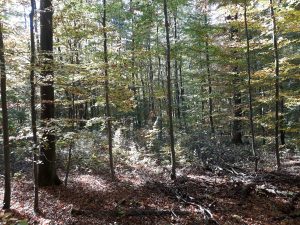
“Qualification–Dimensioning” (QD) strives for the best integration into the natural dynamics of woodland ecosystems. Both the observation and careful assessment of above-ground interactions between trees provide the framework for targeted management practices. As a comprehensive methodology, QD offers a reliable basis for the production of very high added value stems in a small number of trees with very large crowns. Although these stems prdouce a low proportion of the total volume from the overall stand, they make a very high contribution to the total added economic value whilst reducing management costs. Additionally, woodlands and forests managed under QD have considerable scope to provide for high value ecosystem and biodiversity services without compromise to high value timber objectives.
QD can be applied to woodlands of any composition and structure. It enables the straightforward conversion of young, even-aged forests into uneven-aged, continuous cover woodlands. QD allows for a wide range of tree species to be included in the mixture.
Qualification: During the early period of their dynamic height growth, the spontaneous development of the trees is given free rein to select according to vitality. Intimate contact between the trees drives the processes of differentiation and structuring. The effects of these processes intensify and solidify with each subsequent vegetation period. QD does not intervene in this spontaneous process in any substantial way. In terms of management, it is only important to ensure that there will be sufficient options in terms of number, distribution and species diversity when the time comes to select the target-trees.
Dimensioning: Once the desired knot-free stem height has been reached, the target-trees for the production of added value are selected. The intended branch-free stem height for the target-trees in QD is around 25% of their final height. Throughout the dimensioning phase, the target-trees are favoured by repeated interventions to exclude the death of branches at their crown base an to make sure that their crown spread progresses unhindered.
Maturation: Once a target-tree has reached 75-80% of its final height, crown contact with other target-trees is harmless.
Regeneration and Establishment: Regeneration is a perpetual process that sets in when trees are in their advanced dimensioning phase. Any operations and investments, including planting if necessaray, are restricted to clumps measuring 5 to 7 metres in diameter, spaced 12 to 18 (24) metres apart. These clumps ensure sufficient recruitment of future target-trees.
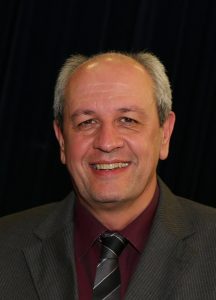
Georg Josef Wilhelm
Georg Josef Wilhelm was born in 1957 and completed his Forest Sciences studies at the University of Freiburg in 1981. Following careers as a forest planner, forest office manager and department head at the Central Office of the Forestry Administration of Rhineland-Palatinate, he served as a senior official in the Ministry of Climate Protection, Environment, Energy and Mobility of Rhineland-Palatinate from 2015. Until his retirement in June 2023, he was responsible for close-to-nature forest management, forest protection, forest planning, and forest research. From 2005 to 2019, he was a member of the Scientific Council of the French National Forestry Office (ONF).
He developed the close-to-nature forest management strategy Qualification-Dimensioning (QD), which has been playing an important role in Rhineland-Palatinate for more than 30 years now.
He has close ties to practical forestry through his honorary engagement, including 10 years as first deputy mayor, in the town of Blieskastel with its 1,900-hectare municipal forest. However, his most significant connection to continuous-cover management is his own private woodland in north-eastern France, which was awarded the Nature Impact Fund of WWF France in 2025.
To book your place please visit this link.

 CCFG will be hosting their next webinar – Why do we need to be concerned about deer? – with David Jam – on Thursday 20th November at 4pm GMT.
  management, at a practitioner, operational and strategic level within the public and private sector.
 CCFG will be hosting their next webinar – Woodland Ecosystems and Carbon – with Tom Crowther and Kate Holl – on Thursday 16th October at 4pm BST.
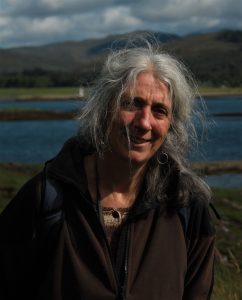 Kate Holl has been a woodland advisor with NatureScot and its predecessors for almost 40 years, specialising in assessing woodland habitat condition, particularly the evaluation of herbivore impacts in natural woodland. She is a joint author of the Woodland Herbivore Impact Assessment method, and in 2017 under a Churchill Fellowship, travelled widely within the North Eastern Atlantic bioregion to learn about the flora of woodlands less impacted by herbivores.
 CCFG will be hosting their next webinar – Biomass – Fuel – Silviculture: The role of CCF in fire prevention- with Alex Held – on Thursday 23rd January 2025 4-5.30pm.
  Freiburg University, Germany. He started as a fire ecologist at the Fire Ecology working group of the Max-Planck Society, got a number of operational qualifications in the US and South Africa. He moved from fire ecology to fire management and worked with the Global Fire Monitoring Center GFMC in Europe and Southern Africa. Later, Alex worked with the South African Working on Fire Program, from its early beginnings till 2012, when he joined EFI.
 north of Scotland on private estates for Cawdor Forestry Ltd. She has been fortunate to have worked in forests where she has been able to practice CCF, almost exclusively with Scots pine using group selection systems or strip felling. Hazel has learnt that CCF requires a lot of patience and that you don’t always get it right first time! She’s also starting to underplant larch and initiate regeneration of Douglas fir.
 years’ experience across a range of jobs and countries. He has managed silvicultural research in the UK and in Somalia, Lesotho, Vanuatu and Guyana covering natural forest through to plantations and temperate to tropical and across a range of different cultural environments. Currently Andrew is part of a team at Forest Research conducting silvicultural and wood properties research, with specific responsibility for CCF, short rotation forestry and species mixtures. For twenty four years he led the development and management of undergraduate and postgraduate degree courses in forestry, delivered through part-time, distance-learning and full-time teaching at the National School of Forestry.
 industry since the 1980’s and operated as an independent manager and consultant since 1997, he has considerable experience in a broad range of forestry related issues. David’s client base includes large estates, voluntary organisations, public sector and smaller privately owned woodlands, covering a range of forest and woodland types. David has particular expertise in timber harvesting and marketing. He is a director of SelectFor Ltd and Partner of D&H Pengelly Forestry & Agi-environment Consultants. David is responsible for several properties where owners’ objectives are met through the long-term application of Continuous Cover Forestry principles, resulting in the emergence of well-developed permanently irregular stand structures.
 Following the webinar on 23rd May with Victoria Stokes talking about an experiment in underplanting in conifers at Clocaenog Forest, a recording has now been made available on YouTube which